
A deep-sea drama is unfolding on this planet of shark science. An thrilling scientific file of a uncommon species in a brand new place would possibly really simply be a photograph of a plastic toy.
By revealed commentary, tweets, and in conversations with Gizmodo, biologists, shark fans, and different consultants have expressed excessive skepticism that an alleged picture of a goblin shark actually exhibits a once-living animal.
If it have been genuine, the picture in query can be the first-ever file of the species within the Mediterranean Sea—a notable and necessary vary growth for the unusual animal. But when it’s really an image of a toy goblin shark, as a number of sources counsel, it’s a cautionary story about citizen science, negligent enhancing and peer evaluate, and the strain scientists face to publish new findings as quick and often as potential.
To unravel this shark controversy, let’s begin at first.
The Revealed File
Final yr, scientists published a paper during which they documented a supposed juvenile goblin shark specimen, discovered useless and washed up on a seaside in Greece. It was the primary time one of many nightmarish looking deep sea-sharks had ever been noticed within the Mediterranean Sea, in keeping with the article revealed within the journal Mediterranean Marine Science in Might 2022. In that paper, the researchers mentioned they’d been despatched the {photograph} by a citizen scientist; not one of the crew had personally seen or examined the specimen.
G/O Media could get a fee

35% off
Samsung Q70A QLED 4K TV
Save massive with this Samsung sale
For those who’re able to drop some money on a TV, now’s a good time to do it. You possibly can rating the 75-inch Samsung Q70A QLED 4K TV for a whopping $800 off. That knocks the value all the way down to $1,500 from $2,300, which is 35% off. This can be a lot of TV for the cash, and it additionally occurs to be top-of-the-line 4K TVs you should purchase proper now, in keeping with Gizmodo.
Goblin sharks are elusive creatures, not often seen useless or living. Not a lot is understood about their replica or habits, largely as a result of they spend most of their lives hundreds of toes beneath the floor of the ocean. They’re considered widely distributed, and legit specimens have been discovered in numerous components of the Atlantic, Pacific, and Indian Oceans. But nobody had ever revealed proof of a goblin shark within the Mediterranean Sea, till this research.
Months after that first publication, in November 2022, a bunch of ichthyologists and impartial researchers responded with a comment on the preliminary paper, in the identical scientific journal, questioning the specimen’s legitimacy. “On shut examination of this picture…doubts come up concerning the authenticity,” they wrote. The commenters listed 10 causes for his or her skepticism, from the form of the jaw and different bits on the “specimen” within the {photograph}, to the wrong variety of gills, the rigidity of the fins, and the shortage of element within the article description.
In response, the unique research authors revealed their own follow-up comment in January—doubling down on the specimen’s authenticity and trying to rebut every of the considerations. Each feedback have been revealed on-line for the primary time this Monday.
A Rebuttal to a Rebuttal
But with the rebuttal, inconsistencies and extra holes emerged, and the goblin shark truthers stay unconvinced. “In my view, it’s a mannequin of a such a shark,” mentioned Jürgen Pollerspöck, an impartial shark researcher and lead writer of the November 2022 remark, in an e mail to Gizmodo. When he first noticed the image, he mentioned he “instantly observed the ‘unnatural look’ of the shark. Stranded animals typically present accidents or indicators of decomposition.” However the photographed specimen didn’t.
He additionally identified that the unique article described a supposedly juvenile goblin shark, with an estimated size of 80 centimeters. Of their reply, the authors mentioned that, really, the citizen scientist estimated the entire specimen size of 17 to twenty centimeters, and it may probably be a shark embryo, not a juvenile. In Pollerspöck’s view, 20 centimeters is simply too small to be a viable goblin shark, immature, embryonic, or in any other case.
Gizmodo reached out to the lead researcher who had initially revealed the alleged goblin shark file, in addition to the editor in chief of the journal. Neither responded by time of publication.
The Web Weighs in
In the meantime, the ‘is it an actual shark’ dialogue had shifted on-line. David Shiffman, a shark ecologist and marine biologist, weighed in on Twitter in at least two different threads. In one tweet, Shiffman posted an eBay link to a mannequin toy goblin shark that appears a very good match for the picture.
Deep-sea ecologist Andrew Thaler additionally chimed in on Twitter to say he was satisfied by the actual eBay toy. “The thriller involves an finish. It’s a toy shark,” he wrote. In an e mail to Gizmodo, he clarified: “That is outdoors my space of experience… My solely remark is that it appears to be like an terrible lot like a toy shark.”
A number of shark fans responded to Thaler and Shiffman’s tweets, affirming their observations that the photographed “shark” appears to be like very very like the toy shark.
However one marine researcher took the search additional. Matthew McDavitt, who’s a lawyer by commerce however a broadcast impartial shark researcher in his free time, compiled his personal picture comparisons and report on the controversy, which he shared with Gizmodo.
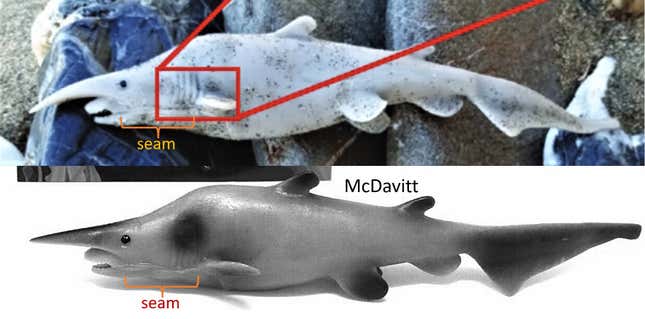
The unique picture “simply seemed off,” McDavitt informed Gizmodo in a telephone name. He cited the drooping rostrum, tail, and mouth as issues that didn’t add up along with his information of precise goblin sharks. He additionally reiterated Pollerspöck’s concern about measurement. “It simply didn’t look proper.”
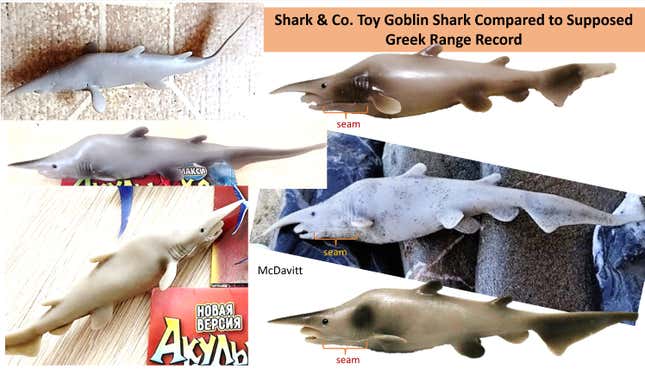
McDavitt mentioned this wouldn’t be the primary time {that a} false picture had been revealed as proof of a fish vary growth (sure, sharks are fish). The researcher relayed a narrative during which he beforehand observed some inconsistencies in an image of a uncommon African wedgefish, revealed as first proof of that species residing off the coast of a São Tomé Island—the place it had by no means been seen earlier than. Finally, he mentioned, the image turned out to be of a special species (a Taiwanese wedgefish), and had been taken of a captive animal in a Portuguese aquarium. A photographer had fraudulently handed it off as a dive picture.
Conditions like this, he mentioned, can have actual detrimental impacts on researchers. McDavitt famous that, within the wedgefish instance, he ended up listening to from some scientists who had been ready to fund an expedition to survey the waters off of São Tomé to search out extra examples of the uncommon fish. Clearly, they might’ve been disenchanted.
A marine biologist who requested anonymity out of worry {of professional} hurt informed Gizmodo in a telephone name that he’s fairly assured the goblin shark picture is a faux. Upon first wanting on the picture, he felt it wasn’t proper, he mentioned. The scientist defined that this isn’t how most species information are offered—with a single {photograph} with out even a scale bar.
Although he doesn’t know the publishing scientists personally, he doesn’t consider they’d malicious intentions. In his view, they didn’t do due diligence. Whether or not the citizen scientist who despatched them the picture knew it wasn’t an actual goblin shark or not isn’t clear, he mentioned.
Each the marine biologist and McDavitt mentioned a serious difficulty right here is negligence on the a part of the publishing journal and the final strain inside academia to publish new and thrilling findings. Essentially the most accountable and finest final result right here can be for both the unique researchers to withdraw their paper or for the journal to difficulty a retraction, each mentioned.
Pollerspöck echoed the sentiment. The lead researcher on the goblin shark research is a scholar, he identified. “In my view, the issue and accountability lies extra with the editor of the journal and the reviewers,” he wrote to Gizmodo. He’s “satisfied that it was an accident,” on the unique authors’ half.
It’s Incredible. Is It Plastic?
Marine scientists and shark fans aren’t the one ones who informed Gizmodo the “goblin shark” specimen appears suspect. Two plastics consultants echoed considerations concerning the veracity of the alleged fish.
“I believe it’s very potential that it may very well be [a] degraded plastic toy,” Joana Sipe, a plastic degradation researcher at Duke College, informed Gizmodo in a telephone name. Sipe mentioned she couldn’t probably make certain, as the one option to decide the fabric can be to examine it immediately, however that a lot of elements of the picture counsel the “shark” may very well be a molded artificial materials.
She agreed that the road subsequent to the mouth may simply be a seam from machine-molded plastic. Then there are the flecks of what may very well be sand, or would possibly as a substitute be remnant plastic dye sticking to the mannequin. Sipe additionally identified the “L” formed darkish imprint on the tail, which she mentioned seemed like intentional shade shading.
Additional, the droopiness of the tail and rostrum (i.e. shark snout), and light shade may very well be the results of warmth or put on on a plastic toy—particularly left out within the solar on a Greek seaside, Sipe added.
Greg Merrill, a Duke College graduate scholar who research plastic air pollution in marine mammals, additionally believed the photographed “animal” was a plastic mannequin. “I’m not a shark knowledgeable; I research whales and plastic,” he wrote to Gizmodo in an e mail. Nonetheless, “I’m assured it is a toy,” he mentioned.
His critique echoed these of different researchers; he additionally identified the shortage of picture scale and the lax description within the unique publication. He famous that it’s extremely uncommon to discover a totally intact specimen of any marine organism washed up on a seaside. “Scavengers—crabs, gulls, and many others—are eager on a free meal and can typically eat smooth tissues, just like the eyes, nearly instantly,” Merrill wrote. That’s, “if the animal ever makes it ashore” to start with.
Trending Merchandise